Category: Poem

  • Consider the cincture

    Consider the cincture

    Blessed are those slaves whom the master finds alert when he comes; truly I tell you, he will fasten his belt and have them sit down to eat, and he will come and serve them.”
    Luke 12:35-37

    We speculated. How
    to translate “fasten
    his belt” in mind’s
    eye? Service, yes,
    to be sure. Battle
    metaphor? Apron?
    Further searching
    yields history, both
    social and literary.
    Rich in meaning,
    a treasure, though
    largely different
    for the genders. Must
    explore the strands
    more. Mostly to do
    with prowess or
    virginity. Somehow
    all of this ties, becomes
    parabolic.

    Cincture is the Latinate
    form; girdle, Anglo-Saxon–
    think Thor, St. George,
    Gawain.

    None of us seated,
    clergy or laity,
    considered the cincture.
    Woven cord worn
    (and often well-worn),
    to yoke the alb, while
    we serve at table.
    Encompassing belt;
    reminder of limits. No
    purse nor sword, just
    love.

    Now
    this 
    is what
    it
    means to
    gird your loins.


  • Distracted Women

    Distracted Women

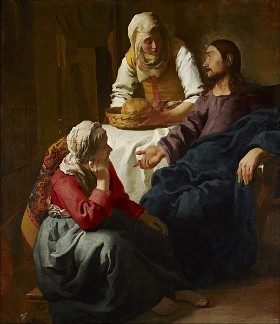
    But the Lord answered her, “Martha, Martha, you are worried and distracted by many things; there is need of only one thing. Mary has chosen the better part, which will not be taken away from her.”  Luke 10:41-42 (NRSV)

    perispaó: to draw away, from Strong’s Concordance

    Is it Martha whose head is being turned?
    Cooking, cleaning, what else to worry on?
    Drawn away, weighed down, hampered–
    oh, yes, laundry in piles. Distractions acting
    upon her; Luke actively bestows passivity;
    she passively surrenders her will.

    The better part. The women here today
    retreating, 
    writing silently in camaraderie, safe
    from the distractions of life–children, cats, media–
    unencumbered in these precious hours.

    Focused. A corporate man’s word?
    Can we be women in this man’s world?
    Or will we be driven mental, closeted first wives?

    Possessed. Consumed.
    Demons. Witches. Fires at the stake.
    Conformity at stake.
    Electroshock therapy for those
    not Martha enough. But Marys
    risked the danger, too.

    Cumbered, oh most lovely and clunky
    word, Shakespearean-sounding verb. Chosen
    betimes for King James and all the English world.
    Come hither and lend us thy sense.

    Can you not see the weights tied
    to Martha’s wrists, ankles? An x-ray
    would show the cartoon marbles
    rolling ’round. They threaten to burst
    her brain. Will the Messiah catch them if they do?

    Is this solely a woman’s madness? Obsession
    (oh, Calvin Klein, oh, Ahab, oh, Augustine)
    is Mary’s game, too. But she is drawn forward,
    is she not, by the scent of wisdom? No apostasy,
    no need for metanoia. No spinning ’round
    and ’round, just loving focus in silent contemplation.

    Thank goodness Luke didn’t write that Martha talks too much.

    Distraction–so dry a word, so
    intellectual. So
    forbidden.
    In her basement carrel, she writes.
    Service to others
    beckons.
    She feels those squirrely marbles;
    constantly rolling,
    drawing
    her out to the world. The better part,
    or simply more
    squirrels?

    Encumbered by love, and probably sibling rivalry,
    Mary and Martha are yoked, an easy burden or no?

    Jesus knew we’d always be chasing squirrels.
    Women are human, too.


    Artwork: Christ in the House of Mary and Martha, attributed to Johannes Vermeer, from the Google Art Project

  • Ecce gratia

    Ecce gratia

    This is a reflection I wrote last week for the Good Friday Project that St. James Episcopal Church presented on April 19, 2019. It’s an annual program they present, a variety of artists from their community, and from other churches in the area, offer pieces of music, poetry, dance, and more, in a contemplative setting.

    Part I: Ecce homo “Behold the man”
    “It is finished.”
    They long for the final 
    exhalation, these lips that still
    pucker at the tang of sour wine;
    Arid gust swirls a faint muskysweet  po
    scent upward from the Mary who
    kneels at the foot of my cross.
    Ah, I recall the rough silk of her
    hair on my feet. Nard for burial
    while I breathed and lived. Her gesture 
    was for me; she graced my death,
    where Peter and the others could not.
    There, my mother and my beloved disciple;
    no man can sunder such love.
    I focus on their loved faces and my pain
    subsides. 
    Ecce homo, Pilate commanded.
    Demanded the city look and see.
    He did not ask of me, ecce populus;
    no matter, all is Rome’s
    Ah, but I love them nonetheless.
    They know not how scorn
    echoes down the ages.
    Father, I will bear the agony
    that in the garden began. 

    Part II: Ecce tibi “Behold oneself”
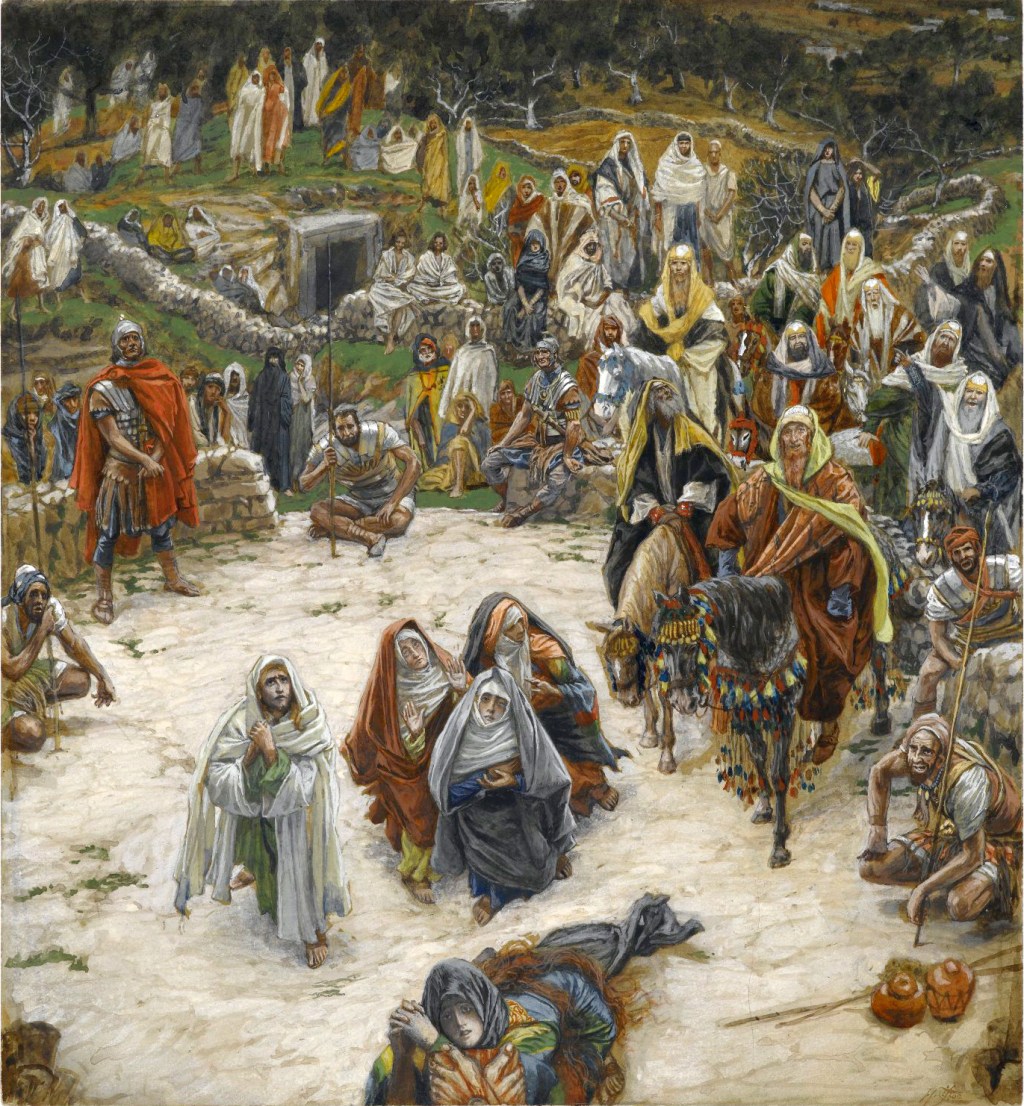
    Boston in spring 2007. Our heroine, a grad student presenting at a national conference. Pop Culture—easy to get into, true–exciting, nonetheless. Her paper all about quest literature. The lesson: there’s no one in Avalon to save us; we must save ourselves. Medieval studies sessions catch her attention. The grail’s in Boston, she learns—alive and well in the public library. So, on that Friday in glorious spring, she’s skipping out to quest and finds Edwin Abbott’s eerie paintings in the library’s reading room. Perceval’s gaze still haunts her dreams, and the Holy Grail, that sacred cup, is unveiled in sacred, public space. Behold! What a joyous day with still time to quest. Out into the square she steps. Across the way, a well-aged church beckons her; come. No hesitation, off she goes, such pride in all she’s accomplished. “You can’t take pictures, she’s told at the door, “but please come in and be seated in silence.” The usher hands her a bulletin. It’s not until she’s seated and seen the quote straight back on the wall of the nave–He who does not love does not know God, for God is lovedoes she see the words on the top of the pageGood Friday—come in and pray. Our heroine weeps with sudden understanding: salvation and God have been present all along. She’s just finally been opened to God’s call. 

    Part III: Ecce ipsi “Behold ourselves
    Have you heard the prophet C. S. Lewis’ words? 
    “No man can be an exile if he remembers that all the world is one city.”  

    Part IV: Ecce familia 
    Today, we stand outside of time and watch and pray.
    Behold thy family, graciously, O Lord.
    Love again begins. 


    Credits: The C. S. Lewis quote is from Till We Have Faces. The featured image is What Our Lord Saw From the Cross, by James Tissot, painted between 1886 and 1894.

  • Gotta love that brood of vipers

    Gotta love that brood of vipers

    John’s passion, will it ever find satisfaction?

    Met a parishioner today who wanted to volunteer
    to help our homeless neighbors.
    “I can do something that doesn’t require physical contact?”
    Touch them, seriously, do I have to?
    But her cash is indeed welcome
    to provide creature comforts–
    bus passes, restaurant gift cards, socks.
    That counts as touching, right?

    John’s passion, will it ever find satisfaction?

    And what about you, aghast that anyone
    would ask that question
    with such revulsion.
    Your own repulsion, as if a snake had reared its hood.
    Well, that’s a bad metaphor, because you love snakes;
    maybe not love, but they’re God’s creatures, too,
    oft maligned, oft destroyed (that saint made his reputation by
    clearing them out of Ireland).

    Your soul recoils
    Isn’t she a viper because her desire
    to give prophylactic help,
    to remain untainted,
    doesn’t that make her sterile?
    Doesn’t that make her blind, and render,
    yet again, 
    the homeless invisible
    “There are homeless in this hygenic place?” 
    Yes, here. And here. And here.

    John’s passion, you brood of vipers, when will it gain satisfaction?

    Are you worth more just because,
    regardless of your unfitness, 
    you would yet be in the trenches?
    Would not hesitate (unlike that dear rock
    on which the church is founded)
    to untie the thongs of his sandals,
    enduring dung-tinged dirt that would sting
    any viper’s scent-seeking tongue,
    you would welcome and wash.
    Be a foundation of hospitality.

    When will your passion find its satisfaction?
    Or are you looking for self sanctification?

    Open your heart to all,
    forego judgment,
    yield to compassion.
    God can raise stones in your place, too.