Tag: Jesus

  • “. . .easier for others to believe in God.” All Saints’ Day, 11.3.19

    “. . .easier for others to believe in God.” All Saints’ Day, 11.3.19

    Saints are persons who make it easier for others to believe in God. —Nathan Söderblom  

    This quote arrived in my inbox on October 31, the eve of All Saints’ Day, from Synthesis Today, a subscription service that sends a quote from great spiritual and theological thinkers each day—they pertain to the lectionary readings for each upcoming Sunday. Söderblom’s words have rested in my heart and mind for the last couple of days. 

     When I was young—about nine years old, I read about the saints, from a Roman Catholic perspective, though I’m basically from a Lutheran background. Their stories fascinated me; I found them romantic and heroic. Of course, I wanted to be one—giving one’s self to Jesus Christ, to God, meant being elite, virtuous, superhuman. I also understood this to be unattainable by ordinary mortals like me.  

    My perspective on saints has changed much since then, especially once I became an Episcopalian about ten years ago and did a little more learning through experience and reading. Many Episcopal churches celebrated Sunday, November 3, rather than Friday as All Saints’ Day, which is a Principal Feast Day for us. It takes precedence over any other observance, and expresses “the intercommunion of the living and the dead in the Body of Christ,” as the Episcopal Diocese of Newark’s website so well defines the celebration. In many services, intercessors recognize loved ones and church members who have died in years past. This litany, often read aloud, serves as a reminder of the Episcopal tradition that saints are those who share a life in Christ—all faithful Christians, as Luke writes in Acts 9 for example.  

    Söderblom’s words, though simple at first glance, carry much weight as I conside the names of my loved ones who have died, regardless of whether my Grandpa John or Grandma Gert intentionally acted in ways designed to bring me closer to God. Their love and encouragement and the examples they set in their day-to-day lives certainly kept the way open. I imagine that others, hearing the names of loved ones, either aloud or within the spaces of your heart, might be thinking of the ways in which those people made it easier to believe in God.  

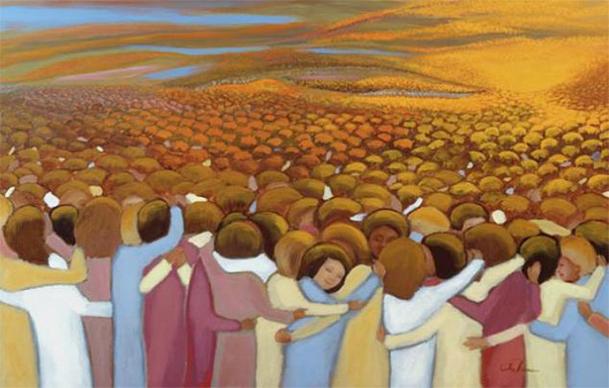
    On this day, and in the days to come, let us be together, the community of saints, followers of Christ, gathered around altars and tables in the sight of the great cloud of witnesses who have held the way open for all of us. 


    This appeared in slightly different form in November 3 issue of The Trumpet, the weekly publication of St. Michael’s Episcopal Church in Austin, TX

    Artwork is “The Communion of the Saints, for All Saints” by Ira Thomas; http://www.catholicworldart.com.

  • Consider the cincture

    Consider the cincture

    Blessed are those slaves whom the master finds alert when he comes; truly I tell you, he will fasten his belt and have them sit down to eat, and he will come and serve them.”
    Luke 12:35-37

    We speculated. How
    to translate “fasten
    his belt” in mind’s
    eye? Service, yes,
    to be sure. Battle
    metaphor? Apron?
    Further searching
    yields history, both
    social and literary.
    Rich in meaning,
    a treasure, though
    largely different
    for the genders. Must
    explore the strands
    more. Mostly to do
    with prowess or
    virginity. Somehow
    all of this ties, becomes
    parabolic.

    Cincture is the Latinate
    form; girdle, Anglo-Saxon–
    think Thor, St. George,
    Gawain.

    None of us seated,
    clergy or laity,
    considered the cincture.
    Woven cord worn
    (and often well-worn),
    to yoke the alb, while
    we serve at table.
    Encompassing belt;
    reminder of limits. No
    purse nor sword, just
    love.

    Now
    this 
    is what
    it
    means to
    gird your loins.


  • Distracted Women

    Distracted Women

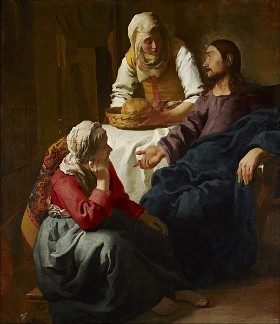
    But the Lord answered her, “Martha, Martha, you are worried and distracted by many things; there is need of only one thing. Mary has chosen the better part, which will not be taken away from her.”  Luke 10:41-42 (NRSV)

    perispaó: to draw away, from Strong’s Concordance

    Is it Martha whose head is being turned?
    Cooking, cleaning, what else to worry on?
    Drawn away, weighed down, hampered–
    oh, yes, laundry in piles. Distractions acting
    upon her; Luke actively bestows passivity;
    she passively surrenders her will.

    The better part. The women here today
    retreating, 
    writing silently in camaraderie, safe
    from the distractions of life–children, cats, media–
    unencumbered in these precious hours.

    Focused. A corporate man’s word?
    Can we be women in this man’s world?
    Or will we be driven mental, closeted first wives?

    Possessed. Consumed.
    Demons. Witches. Fires at the stake.
    Conformity at stake.
    Electroshock therapy for those
    not Martha enough. But Marys
    risked the danger, too.

    Cumbered, oh most lovely and clunky
    word, Shakespearean-sounding verb. Chosen
    betimes for King James and all the English world.
    Come hither and lend us thy sense.

    Can you not see the weights tied
    to Martha’s wrists, ankles? An x-ray
    would show the cartoon marbles
    rolling ’round. They threaten to burst
    her brain. Will the Messiah catch them if they do?

    Is this solely a woman’s madness? Obsession
    (oh, Calvin Klein, oh, Ahab, oh, Augustine)
    is Mary’s game, too. But she is drawn forward,
    is she not, by the scent of wisdom? No apostasy,
    no need for metanoia. No spinning ’round
    and ’round, just loving focus in silent contemplation.

    Thank goodness Luke didn’t write that Martha talks too much.

    Distraction–so dry a word, so
    intellectual. So
    forbidden.
    In her basement carrel, she writes.
    Service to others
    beckons.
    She feels those squirrely marbles;
    constantly rolling,
    drawing
    her out to the world. The better part,
    or simply more
    squirrels?

    Encumbered by love, and probably sibling rivalry,
    Mary and Martha are yoked, an easy burden or no?

    Jesus knew we’d always be chasing squirrels.
    Women are human, too.


    Artwork: Christ in the House of Mary and Martha, attributed to Johannes Vermeer, from the Google Art Project