Tag: theology

  • “. . .easier for others to believe in God.” All Saints’ Day, 11.3.19

    “. . .easier for others to believe in God.” All Saints’ Day, 11.3.19

    Saints are persons who make it easier for others to believe in God. —Nathan Söderblom  

    This quote arrived in my inbox on October 31, the eve of All Saints’ Day, from Synthesis Today, a subscription service that sends a quote from great spiritual and theological thinkers each day—they pertain to the lectionary readings for each upcoming Sunday. Söderblom’s words have rested in my heart and mind for the last couple of days. 

     When I was young—about nine years old, I read about the saints, from a Roman Catholic perspective, though I’m basically from a Lutheran background. Their stories fascinated me; I found them romantic and heroic. Of course, I wanted to be one—giving one’s self to Jesus Christ, to God, meant being elite, virtuous, superhuman. I also understood this to be unattainable by ordinary mortals like me.  

    My perspective on saints has changed much since then, especially once I became an Episcopalian about ten years ago and did a little more learning through experience and reading. Many Episcopal churches celebrated Sunday, November 3, rather than Friday as All Saints’ Day, which is a Principal Feast Day for us. It takes precedence over any other observance, and expresses “the intercommunion of the living and the dead in the Body of Christ,” as the Episcopal Diocese of Newark’s website so well defines the celebration. In many services, intercessors recognize loved ones and church members who have died in years past. This litany, often read aloud, serves as a reminder of the Episcopal tradition that saints are those who share a life in Christ—all faithful Christians, as Luke writes in Acts 9 for example.  

    Söderblom’s words, though simple at first glance, carry much weight as I conside the names of my loved ones who have died, regardless of whether my Grandpa John or Grandma Gert intentionally acted in ways designed to bring me closer to God. Their love and encouragement and the examples they set in their day-to-day lives certainly kept the way open. I imagine that others, hearing the names of loved ones, either aloud or within the spaces of your heart, might be thinking of the ways in which those people made it easier to believe in God.  

    On this day, and in the days to come, let us be together, the community of saints, followers of Christ, gathered around altars and tables in the sight of the great cloud of witnesses who have held the way open for all of us. 


    This appeared in slightly different form in November 3 issue of The Trumpet, the weekly publication of St. Michael’s Episcopal Church in Austin, TX

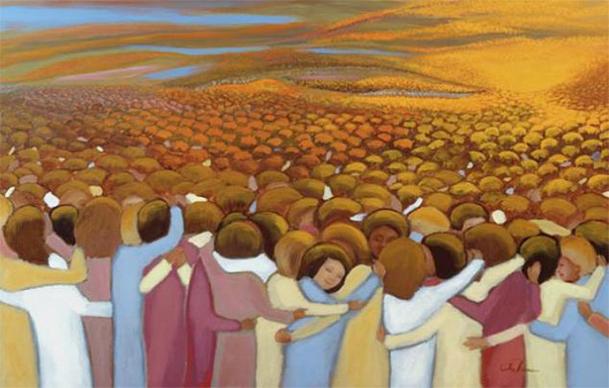
    Artwork is “The Communion of the Saints, for All Saints” by Ira Thomas; http://www.catholicworldart.com.

  • Consider the cincture

    Consider the cincture

    Blessed are those slaves whom the master finds alert when he comes; truly I tell you, he will fasten his belt and have them sit down to eat, and he will come and serve them.”
    Luke 12:35-37

    We speculated. How
    to translate “fasten
    his belt” in mind’s
    eye? Service, yes,
    to be sure. Battle
    metaphor? Apron?
    Further searching
    yields history, both
    social and literary.
    Rich in meaning,
    a treasure, though
    largely different
    for the genders. Must
    explore the strands
    more. Mostly to do
    with prowess or
    virginity. Somehow
    all of this ties, becomes
    parabolic.

    Cincture is the Latinate
    form; girdle, Anglo-Saxon–
    think Thor, St. George,
    Gawain.

    None of us seated,
    clergy or laity,
    considered the cincture.
    Woven cord worn
    (and often well-worn),
    to yoke the alb, while
    we serve at table.
    Encompassing belt;
    reminder of limits. No
    purse nor sword, just
    love.

    Now
    this 
    is what
    it
    means to
    gird your loins.


  • Distracted Women

    Distracted Women

    But the Lord answered her, “Martha, Martha, you are worried and distracted by many things; there is need of only one thing. Mary has chosen the better part, which will not be taken away from her.”  Luke 10:41-42 (NRSV)

    perispaó: to draw away, from Strong’s Concordance

    Is it Martha whose head is being turned?
    Cooking, cleaning, what else to worry on?
    Drawn away, weighed down, hampered–
    oh, yes, laundry in piles. Distractions acting
    upon her; Luke actively bestows passivity;
    she passively surrenders her will.

    The better part. The women here today
    retreating, 
    writing silently in camaraderie, safe
    from the distractions of life–children, cats, media–
    unencumbered in these precious hours.

    Focused. A corporate man’s word?
    Can we be women in this man’s world?
    Or will we be driven mental, closeted first wives?

    Possessed. Consumed.
    Demons. Witches. Fires at the stake.
    Conformity at stake.
    Electroshock therapy for those
    not Martha enough. But Marys
    risked the danger, too.

    Cumbered, oh most lovely and clunky
    word, Shakespearean-sounding verb. Chosen
    betimes for King James and all the English world.
    Come hither and lend us thy sense.

    Can you not see the weights tied
    to Martha’s wrists, ankles? An x-ray
    would show the cartoon marbles
    rolling ’round. They threaten to burst
    her brain. Will the Messiah catch them if they do?

    Is this solely a woman’s madness? Obsession
    (oh, Calvin Klein, oh, Ahab, oh, Augustine)
    is Mary’s game, too. But she is drawn forward,
    is she not, by the scent of wisdom? No apostasy,
    no need for metanoia. No spinning ’round
    and ’round, just loving focus in silent contemplation.

    Thank goodness Luke didn’t write that Martha talks too much.

    Distraction–so dry a word, so
    intellectual. So
    forbidden.
    In her basement carrel, she writes.
    Service to others
    beckons.
    She feels those squirrely marbles;
    constantly rolling,
    drawing
    her out to the world. The better part,
    or simply more
    squirrels?

    Encumbered by love, and probably sibling rivalry,
    Mary and Martha are yoked, an easy burden or no?

    Jesus knew we’d always be chasing squirrels.
    Women are human, too.


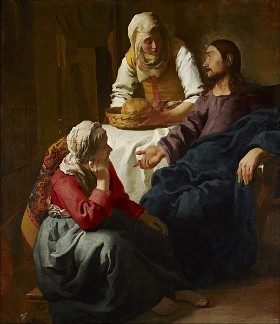
    Artwork: Christ in the House of Mary and Martha, attributed to Johannes Vermeer, from the Google Art Project

  • Why I’m Soul Sister to a Dog: The Canaanite Woman & Me

    Why I’m Soul Sister to a Dog: The Canaanite Woman & Me

    But she came and knelt before him, saying, “Lord, help me.” Jesus answered, “It is not fair to take the children’s food and throw it to the dogs.” She said, “Yes, Lord, yet even the dogs eat the crumbs that fall from their masters’ table.” Matthew 15:25-27 NRSV

    I am a dog.

    One of my closest soul sisters is my friend’s dog. We connect because I understand myself to be a dog in so many ways, in various connotations of the word. I want to claim both those negative and positive aspects, so that I can be whole, as the Canaanite woman is wholly herself, owning the name that Jesus throws at her, which she fetches right back and drops it at his feet.

    As a freshman, “you dog!” was hurled at me across the school library, by boys who felt entitled to degrade me because I didn’t meet their standard of beauty. To be honest, I didn’t—straight-haired brunette. Thick eyebrows. Yes, facial hair. No make-up. No interest in fashion. Very much a Spock-loving, Elvish-speaking, poetry-writing nerd of a girl and mostly proud of it. To do any less than own it, to be the dog, felt fake, untrue. So I was ugly, not fit to date—I owned myself.

    As a non-desired young woman, I came to identify, later in high school, with Helena, from my favorite of Shakespeare’s plays, A Midsummer Night’s Dream. This intensified during my marriage to an emotionally-abusive man who constantly cheated on me. Isn’t that the true place of a “saved” woman?  Fawning over her knight, whom she loved, content to be owned, to have the crumbs from the other women who he’s rescued. In Act 2, Scene 1, while she’s chasing him, Helena tells Demetrius, the man who could heal her: “What worser place can I beg in your love— / And yet a place of high respect with me— / Than to be usèd as you use your dog?”

    I can own that I let myself play well into this role over the last twenty-some years. “I am your spaniel. And, Demetrius, / The more you beat me, I will fawn on you.” Yelps–“like me, like me, like me”–chorus in my background. “Bitch” is the pejorative metaphor I never wanted to hear from anyone’s lips.

    Did the Canaanite woman expect to hear that insult from Jesus? To be called a “dog” or a “bitch”? Some commentators describe Jesus as smiling in his reply to the woman who dares to implore him for help (Women’s Bible Commentary, 474). He uses the word as a kindness, sort of like when one of my male co-workers greets me with a friendly “what’s up, dawg?” Meant in a friendly way, I know—one cool person to another. Not quite feeling that vibe in the exchange between our savior and the woman, though. Perhaps a little more tension between them—Jesus is focused on his mission. And that reading of a smiling Jesus makes him sound so patronizing. “Nice doggy, go lie down”—pat, pat, pat.

    Yet, all along, there’s been another canine shadow pacing quietly alongside these cynical images. For as long as I can recall, when considering my wandering and wondering nature, especially in matters of faith and theology, I’ve described this journey as God letting me out on a very long lead. While exploring other ways of faith-ing, my fidelity has always been given to Christ, despite hackles bristling at rigid dogma or rabid fundamentalism.

    Recently, a new friend gave more shape to this numinous form. He noticed that I didn’t just call myself a dog, but very specifically named myself “hound” without any forethought. A new consideration of myself—after all, I didn’t say any breed considered a toy or a lapdog. Hounds, Jeff observed, are independent and given to tracking by scent or sight their quarry. Leave out of your minds right now the masculine sexual connotations
    –I definitely ain’t nothin’ like that hound dog!

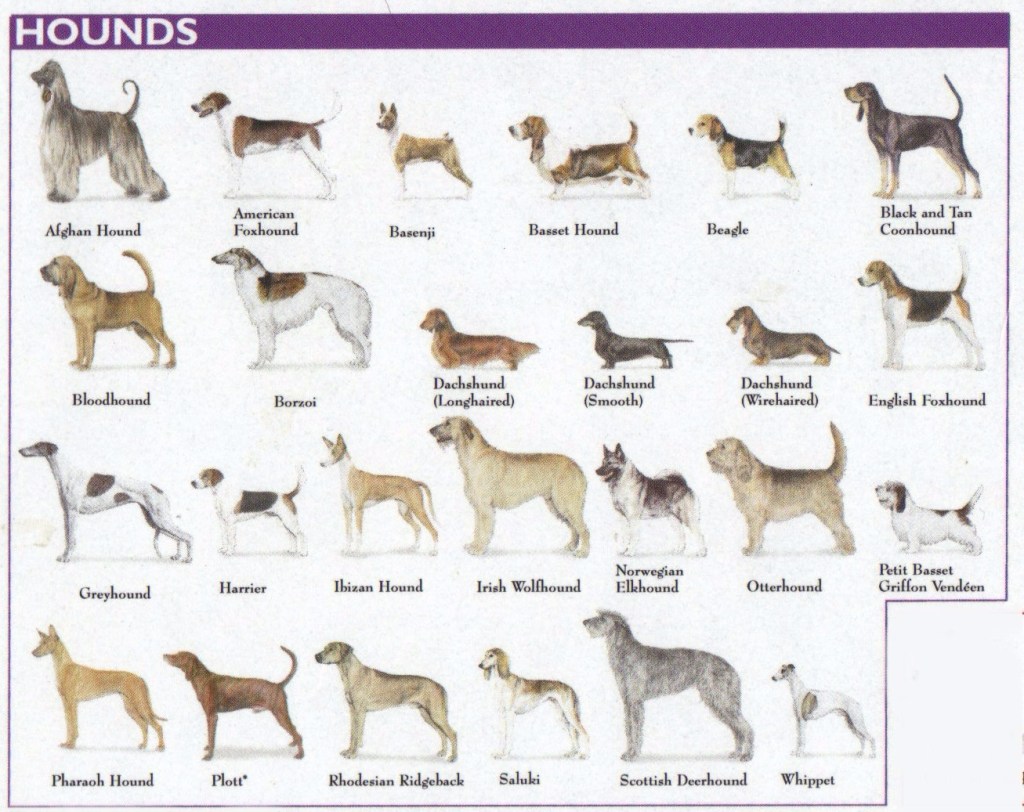
    Do I imagine myself the noble bloodhound, the elegant saluki, the swift greyhound? Maybe. I can claim certain of their aspects. In all honesty, though, I’m most like my Grandpa John’s basset hound, kindred spirit of my childhood—built low to the ground, chasing rabbits (going down rabbit holes), checking out fascinating scents, and generally going my own way around town. Lovingly indulged.

    I’ve done with being the fawning spaniel (with all due respect to my soul sister), waiting to be spurned or beaten, or worse yet, beating myself. The Canaanite woman said “yes, that’s me” to Jesus (great improv!). Her “yes” woke him, reminding him that faith and salvation come in unexpected forms. Her “yes” rouses me, too.

    Yes, I am a dog; a hound as faithful and true as the Canaanite woman. And very grateful that God has never once taken God’s hand from the lead.

  • In Our Addiction to Convenience, Have We Forgotten the Word’s Ancient Meaning?

    In Our Addiction to Convenience, Have We Forgotten the Word’s Ancient Meaning?

    Then the eyes of both were opened, and they knew that they were naked; and they sewed fig leaves together and made loincloths for themselves. Genesis 3:7

    Part of my daily ritual most mornings involves stopping at my local 7-Eleven convenience store. Freedom and spontaneity abound in my breakfast or lunch choices—planning a week’s worth of meals can be so inconvenient. Sometimes I stop at one on the way to my other job when I feel the guilt of a McDonald’s craving—exchanging one convenient corporation for another. Convenience stores have an abundance of those conveniently healthy food choices—individual packets of nuts, yogurt, power bars, and more. Convenience stores are also convenient oases for homeless persons, have you noticed?

    I have a hate/love relationship with the words convenient and convenience. They have become such self-focused words—as consumers in a largely corporate economy, we measure the world in terms of our own “coffee spoon” comfort: how quickly and easily can we gratify our desires? No frustration must enter our lives, heaven forbid that we must wait in line at a grocery store, let alone interact with others who (might) thwart our ease of access. Convenience means little or no human interaction.

    In seminary a few years ago, I became enamored of the now obsolete usage of the word, the original Latin conveniens, which means “fitting.” This usage forms the basis for many of Thomas Aquinas’s arguments in the Summa Theologiae. When I first read it, my eyes opened, not to a brave new world, per se, but to knowledge that there were others like me in the world–scholars, theologians, poets–using reason to understand God; faith was seeking understanding, to borrow St. Anselm’s phrase.

    I had found my kindred spirits. Seemingly, the practical world has little use for mystics, though, let alone poets. And yet, I would say that even these head-in-the-cloud saints still had their hands and feet in the world.

    ***

    Adam and Eve

    God’s economy
    begins in this convenient
    car wash; by spurting spigot,
    the man fills plastic water jugs
    crafted by a nameless
    corporation.
    the woman produces eclectic plastic
    ware–squares, saucers–from ubiquitous
    black garbage bag carryall.
    Synthetic black clothes her corpus, too,
    leadenly animate in the chill.
    Giving each dish a quick rinse under
    the gushes, she then lays
    them out on the grass.
    No shame in either frame
    as each performs their corporate chores.
    Store’s red-shirted clerk ignores
    their theft.

    Gas pump clicks, banishing me
    from this Eden, not them.
    Conveniens? I whisper, a Thomist
    ghost flitting ‘round
    my reasoning heart.
    Fitting, I murmur–
    this is the wisdom of the world.

    ***

    In my off-kilter, poet-theologian mind, I hate that we speak of, say, helping the homeless, in terms of inconvenience, as I’ve heard some priests preach, trying to wrestle with that word. Get out of your comfort zone (such a convenient cliche)! And I don’t disagree with the thought, but . . . if we are all children of God, all imago dei (made in God’s image), then should we not re-frame the wisdom of the world in terms of the fittingness of opening our eyes and truly seeing each other in that light? Inconveniencing ourselves may be the most convenient action we can take.


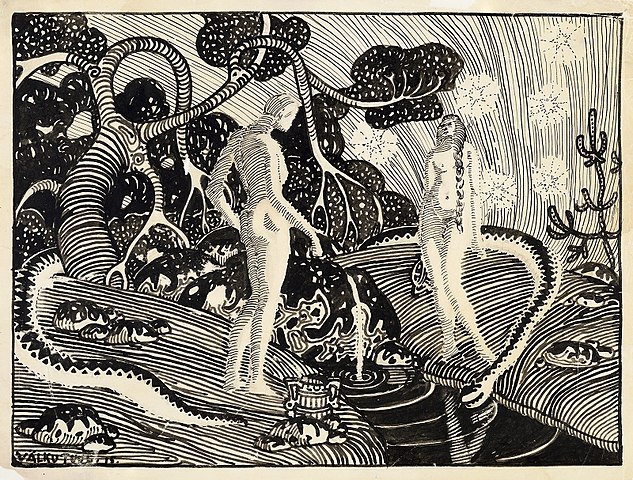
    Image:  Välko Tuul – Art Museum of Estonia, Public Domain, https://commons.wikimedia.org/w/index.php?curid=61409440

  • Advent Anxiety

    This Thanksgiving holiday, I, like many, many, many other people, flew to visit family. This Sunday, like many, many people, I sat in church, celebrating the first Sunday of Advent (Happy New Year to my fellow liturgical geek friends), and listening to part of the gospel of Matthew’s little apocalypse. Every three years, we are given this reading, this lesson, and yet every three years, this passage takes us aback, it seems. Isn’t Advent a season to pull away from the stress and anxiety produced by the constant revelation of newer and better gifts to buy for your children, grandchildren, parents, grandparents, husbands, wives, etc., etc? Aren’t we already awake enough through constant media bombardment, social or otherwise, secular or otherwise? Does this passage encourage us to ever more hyper vigilance for the Second Coming in an age that urges us to ever more uber awareness so that we can grab all that we can now, now, now, before the thief returns to the house? We can be taken or left at any moment. What awaits those taken? Those left? Who is taken; who is left?

    As my outward bound flight taxied to the gate at the Charlotte airport, both a flight attendant and the captain made an announcement regarding those who had tight  connection times to their next flight. Most of those having the small increment of time were seated at the very back of the plane. Could those of us who had a longer time prior to the next stage of the journey or those who had reached our destination please stay seated so those families could disembark quickly and easily. We get parked at the gate, the seatbelt light blinks off, and what happens? Nearly everyone stands up and crowds into the aisle, grabbing for the overhead compartment latches, anxious–gotta off the plane first. A few of us stay seated, waiting as the families in the back rush (a difficult task in a narrow tube) past, with that harried, disheveled look folks traveling with young ones often have. We were thanked, both by those fellow passengers and by the captain.

    How easy and how addictive that anxiety is! That zero-sum-driven angst that almost compels us to act impulsively on the “if I’m not first, I’ll miss something” fear; the “if I’m not first, I’m last” fear. As if being last is necessarily bad. I must admit to that temptation while waiting in the terminal–I arrived early both for the outward, visitation-bound travel and for the journey home; had time to buy refreshments, Dramamine, and a crossword puzzle book; found seats near the appropriate gate; and sat, trying to settle. Pulled out my pen and began a crossword, feeling relaxed, sipping my Coke. Looking up, watching the people going up and down the terminal. Fidgeting in my chair. What time is it? Oooh, the information screen behind the gate desk shows 20 minutes until boarding begins. I know the time. Relax again, puzzle over and answer a few more clues. Look up again, more folks gathering–lots of carry-ons. Great. Sigh. Remind myself not to get anxious; I’ve packed lightly: a duffle bag and a large purse that will both easily fit under the seat in front of me. Doesn’t matter which group I board with, even though my ticket reads “Group 2.”

    More folks start to gather around the gate–why are they standing so close? Will they try to board before their group is called? I fidget more; I’ve put the crossword away and am trying to read my advance reading copy of Tad Williams’ latest fantasy novel. I give up in favor of watching to see how many people take advantage of the courtesy bag checking. I nearly get up to check mine. No, no need to be anxious–I prepared, packed lightly so I wouldn’t have to check a bag or worry about getting a bag into the overhead compartment. I’ll get on the plane, doesn’t matter if I’m first, last, or in the middle. Yes, there will be some discomfort as others get settled, get backpacks or cases stowed, before and after I do. All will be well. But the temptation to share in that anxiety–to get up and get closer to the gate, to stake my place, to glare at others who don’t line up properly, to make sure I’m with my boarding group, to be ahead of other boarding groups, to claim my space and get ready for the scary prospect of take off–is strong. I tuck my boarding pass into my book and I stand.

    To put it another way: if you, as the owner of the house, know that the thief is coming but not the hour that the thief is to arrive, do you sit between now and that time, anxious, hyper vigilant, rigid in an armchair perhaps, smack dab in front of the door, hands tight on a shotgun, afraid to leave the chair? Are you then awake? How else might you prepare?

  • Poem written for McLean Baptist Church

    This poem was commissioned by Rev. Megan Clapp, Youth Minister at McLean Baptist Church in McLean, VA. The first week of August 2016 was VBS time, and the children learning about creative praise. Megan and Katie, the other minister, wanted a poem that could be read at the Sunday worship time by a child, with a playful tone, and be about the church’s worship space.

    The Most Important Part of My Church

    Do I love my church home?
    Yes!
    Why?
    I spy
    beautiful jewels
    emerald, sapphire, amethyst,
    with ruby and gold at the heart—
    the crown and cross
    of Jesus Christ our King.
    Can you guess?
    Yes! Our stained-glass window,
    With colors bright.

    Do I love my church home?
    Yes!
    Why?
    I spy
    simple, strong structure,
    space to grow in Christ.
    Cradling us safely, yet
    with windows clear, and doors
    for all to enter and go forth.
    Can you guess?
    Yes! Our sanctuary walls,
    a welcome sight.

    Do I love my church home?
    Yes!
    Why?
    I spy
    cross and threefold shadows here,
    hovering over waters deep,
    promising eternal life in Christ.
    Before and after I’m immersed,
    Jesus’ teachings I’ll learn to keep.
    Can you guess?
    Yes! Our baptistery,
    With its inner light.

    Do I love my church home?
    Yes!
    Why?
    I spy
    the place that we gather
    to be joined as a body,
    the body of Christ. Together
    in communion at the table,
    where the Word of God often rests.
    Can you guess?
    Yes! Our altar, set for
    the feast of life.

    Do I love my church home?
    Yes!
    Why?
    I spy
    every time I’m here
    the most important part
    of our church—its soul and heart—
    singing, laughing, crying,
    praying, ministering, loving.
    Can you guess?
    Yes! We are the church,
    in our pews together, all
    snug and tight.

    Do we love our church home?
    Yes! We do! Amen!